How to Choose a Massage Chair: 10-Point Buying Checklist (2026)
 B MishraUpdated November 15, 202610 buying factors explained
We earn a commission if you buy through links on this page, at no extra cost to you. As an Amazon Associate we earn from qualifying purchases. It never decides which product we recommend. How we make money
How do you choose a massage chair?
Start with fit: check the chair’s recommended height and weight range. Then pick a roller system (3D for adjustable pressure), an SL-track if you want glutes and hamstrings massaged, enough airbags for arms, calves and feet, heat if you have back stiffness, and zero gravity recline. Finally measure your room, check delivery terms and read the warranty. Budget around $900 to $2,000 for a good mid-range chair in 2026.
Key takeaways
- Body fit decides more about comfort than any feature list.
- A 3D SL-track chair is now available for around $900, so 2D chairs are hard to recommend unless budget is very tight.
- Measure the space needed when fully reclined, not just the chair’s upright size.
- Warranty length, in-home service and return shipping costs vary hugely. Read them before you buy.
- Check with a doctor first if you have osteoporosis, a heart condition, a recent injury or are pregnant.
The 10-point checklist
1. Your height and weight
Every chair has a recommended height range, often around 5’1″ to 6’3″, and a weight limit, often 250 to 300 lb. Outside those, rollers miss your shoulders and the leg rest may stop mid-calf. If you’re tall, check how far the leg rest extends. If you’re short, check whether your feet reach the foot rollers.
2. Roller system: 2D, 3D or 4D
3D lets you adjust how deep the rollers press. 4D adds variable rhythm and costs more. For most people, 3D is the best value. Read our full explanation: 2D vs 3D vs 4D massage chairs.
3. Track type
- S-track: follows your spine from neck to lower back.
- L-track: continues under the seat to the glutes and upper hamstrings.
- SL-track: both. Now common even under $1,000.
If you have tight hips or glutes, an SL- or L-track makes a noticeable difference.
4. Airbags and compression
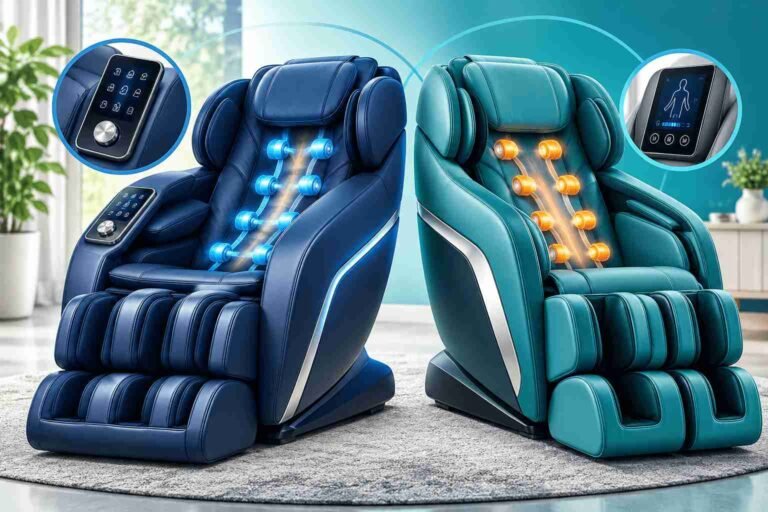
Airbags squeeze the shoulders, arms, hips, calves and feet. Look at how many there are, where they sit, and how many pressure levels you get. Too strong on the arms is a common complaint, so adjustable intensity matters.
5. Heat
Lower-back heat is the most useful. Calf or foot heat is a bonus. Heat is usually mild and slow to warm up. It isn’t a substitute for a heating pad, but it adds comfort.
6. Zero gravity recline
Raises your legs and tilts you back, so the rollers press more evenly. Most chairs from about $800 include it. See what zero gravity actually does.
7. Space and wall clearance
Measure your room. A full-body chair reclined can be 70 inches or more long. Space-saving designs slide forward as they recline and need only a few inches behind them; standard chairs may need a foot or more. Also measure doorways and stairs for delivery.
8. Programs and controls
Six to ten automatic programs are plenty. More useful are manual controls that let you target an area, adjust roller width and change airbag pressure. Check whether the remote is easy to read; app-only controls frustrate some older users.
9. Warranty, delivery and returns
This is where cheap chairs often cut corners.
- Is the warranty 1 year or 3 to 5 years? Does it cover parts, labour and in-home service?
- Is delivery curbside (you carry a 150 to 250 lb box inside) or white glove (they carry, assemble and remove packaging)?
- Can you return it, and who pays return freight? Return shipping on a chair can cost hundreds of dollars.
10. Budget
| Budget (US, 2026) | What you typically get |
|---|---|
| Under $500 | Chair pads and cushions, not full chairs. See our chair vs chair pad guide. |
| $800 to $1,200 | 3D or 3D Lite SL-track, zero gravity, basic heat, foot rollers, 1-year warranty |
| $1,200 to $2,500 | Full 3D, more airbags, calf heat, body scanning, longer warranties on some brands |
| $3,000 and up | 4D rollers, premium build, longer track, extended warranties, white-glove delivery |
Bands are approximate, based on US brand-store prices we checked in October and November 2026.
Red flags when buying
- No stated height range or weight limit.
- Warranty under 1 year, or “parts only” with no labour.
- Huge “was” prices with a permanent 70% discount.
- No clear return policy or a restocking fee over 20%.
- Unverifiable claims that the chair treats medical conditions.
Who should check with a doctor first
People with osteoporosis, heart conditions or a pacemaker, blood clots, recent surgery or fractures, and pregnant women should ask their doctor before using a massage chair. A 2019 case report described a vertebral compression fracture in a person with osteoporosis after using an automated massage chair. Keep children away from the base and moving leg rest. Read more in our guide to massage chair benefits and risks.
Chairs that tick most boxes
How we wrote this guide
We compared specifications, warranties and delivery terms published by massage chair brands, and reviewed a 2023 scoping review of massage chair research and a 2019 case report on massage chair injury. We haven’t physically tested these chairs; prices were checked in October and November 2026. See how we test.
Frequently asked questions
How much should I spend on a massage chair?
What is the most important feature in a massage chair?
Should I buy a massage chair online without trying it?
How long do massage chairs last?
Does a massage chair use a lot of electricity?
B Mishra writes RightMassager’s buying guides, comparing massager specs, prices and owner feedback against published research. More about our team
Sources
- Utilization of massage chairs for promoting overall health and wellness: a rapid scoping review, 2023
- Jeon CH, et al. Electrical automated massage chair use can induce osteoporotic vertebral compression fracture. Osteoporosis International, 2019
- Real Relax: Favor-03 2026 3D Lite
- Real Relax: Favor-06 Classic
- Osaki: 3D Dreamer V2