
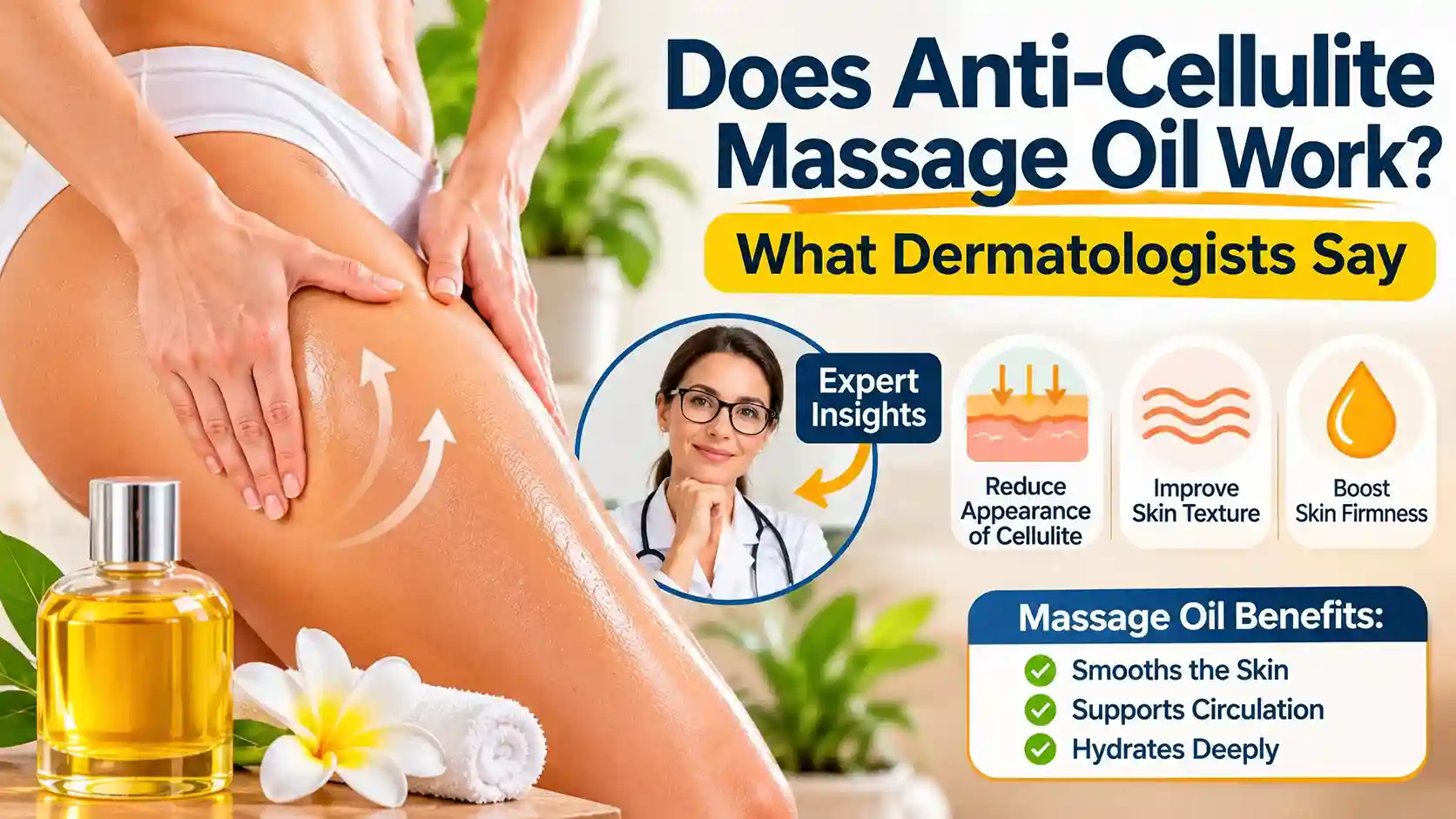
Does Anti-Cellulite Massage Oil Work? What Dermatologists and Research Say (2026)
 B MishraUpdated November 15, 20269 studies and reviews checked, 3 products compared
We earn a commission if you buy through links on this page, at no extra cost to you. As an Amazon Associate we earn from qualifying purchases. It never decides which product we recommend. How we make money
Does anti-cellulite massage oil work?
Not in the way the labels suggest. No oil removes cellulite, because cellulite is caused by bands of connective tissue under the skin that an oil can’t reach. A 2015 systematic review of 67 studies found no clear evidence that any cellulite treatment worked well, and little evidence for creams and oils. Massage can make skin look smoother for a few hours to days, and daily caffeine or retinol products may make cellulite slightly less noticeable. Results are small and fade when you stop.
Key takeaways
- Cellulite affects an estimated 80% to 90% of women after puberty. It is normal and not a sign of being unhealthy or overweight.
- The main cause is the structure of fibrous bands (septae) under the skin, which pull the skin down while fat pushes up between them.
- The best review of cellulite treatments found only 19 of 67 studies were randomised and placebo-controlled, and topical products showed little evidence of benefit.
- Caffeine and retinol are the ingredients with the most research. Effects are modest and need months of daily use.
- Massage gives a temporary smoothing effect by moving fluid and warming the skin. It does not break down fat or “toxins”.
- Procedures that release the fibrous bands, such as subcision, have the strongest evidence, but cost far more and still aren’t permanent cures.
What is cellulite?
Cellulite is the dimpled, “orange peel” or “cottage cheese” look of skin, most often on the thighs, buttocks and hips. It isn’t a disease. Doctors sometimes call it gynoid lipodystrophy.
Under the skin, fat sits in compartments separated by fibrous bands called septae that tether the skin to deeper tissue. In women these bands tend to run vertically, so fat lobules can bulge up between them while the bands pull the skin down, creating dimples. In men the bands form more of a criss-cross mesh, which helps explain why cellulite is much less common in men. A 2020 review in Dermatologic Surgery concluded that the exact cause still isn’t fully understood, but there is compelling clinical evidence that the fibrous septae play a central role.
How common is it?
Very. Reviews widely estimate that 80% to 90% of women develop some cellulite after puberty, across all races and body sizes. Fewer than 10% of men have it, usually linked to low testosterone or hormone treatments.
What makes it worse?
- Hormones: cellulite often appears after puberty and can worsen during pregnancy, when oestrogen levels are high.
- Genetics: it tends to run in families.
- Thinning skin with age: as collagen falls, the bulges show through more easily.
- Weight gain: more fat can make dimpling more visible, though slim people get cellulite too.
- Rapid weight loss: looser skin can make cellulite look worse, not better.
- Inactivity and smoking may contribute, though the evidence is weaker.
What is anti-cellulite massage oil?
It’s a body oil marketed to firm skin and reduce dimpling. Most contain a carrier oil (such as jojoba, almond or wheat germ oil) plus plant extracts and fragrance. Common “active” ingredients include:
| Ingredient | What it’s claimed to do | Evidence |
|---|---|---|
| Caffeine | Boost fat breakdown, tighten skin | Some small studies show modest, temporary improvement |
| Retinol (vitamin A) | Thicken skin and build collagen | Small placebo-controlled trials show modest improvement after about 6 months |
| Birch leaf, butcher’s broom, horse chestnut | Reduce fluid, support circulation | Very little cellulite-specific research |
| Aminophylline, theophylline | Break down fat | Dermatologists say there’s no good evidence these creams work |
| Essential oils (grapefruit, cypress, rosemary) | “Detox” and firm skin | No good evidence; mainly scent |
| Carrier oils (jojoba, almond, wheat germ) | Soften and moisturise | Well-established moisturising effect |
What the evidence says
The big picture: most treatments are poorly studied
In 2015, researchers led by Stefanie Luebberding published the first systematic review of cellulite treatments in the American Journal of Clinical Dermatology. Of the 67 studies they analysed, only 19 were randomised and placebo-controlled. They found no clear evidence of good efficacy for any treatment, with only acoustic wave therapy and a minimally invasive 1440 nm laser showing some sign of potential benefit. On topical products, the team concluded there was little evidence they improve the appearance of cellulite.
Caffeine
Caffeine is the most common active ingredient in cellulite products. In lab studies it can encourage fat cells to release stored fat, and on the skin it may draw water out of cells, making the surface look temporarily tighter. A 2020 review by Bass and Kaminer noted that several studies of creams containing caffeine (from 0.1% to 13%), retinol, or both reported significant improvement in cellulite severity, but the studies were small, used different products and methods, and often had no good placebo control. The American Academy of Dermatology (AAD) says caffeine may temporarily make cellulite less noticeable, and that you need to apply it daily to keep the effect.
Retinol
Retinol is thought to work in a different way: over months, it may thicken the outer layers of skin and boost collagen, so the fat bulges show through less. A small 6-month placebo-controlled trial by Piérard-Franchimont and colleagues (2000) found topical retinol improved skin elasticity and reduced viscosity at treated sites, with a modest visible effect. The AAD says retinol products may make cellulite less visible with at least 6 months of daily use. Retinol can irritate skin, makes it more sensitive to sun, and should be avoided in pregnancy.
Plant extracts and essential oils
Popular extracts such as birch leaf, butcher’s broom, ivy, horse chestnut and gotu kola appear in many oils. Some have been studied for vein health when taken by mouth, but there is very little good research on their effect on cellulite when rubbed into the skin. Essential oils like grapefruit and cypress mostly add scent.
Massage
Massage is where an oil earns its place. Firm strokes push fluid out of the tissues toward the lymph nodes and warm the skin, which can make the surface look smoother for a while. Mechanical massage that combines suction with rollers, known as endermologie, has been cleared by the US FDA to temporarily reduce the appearance of cellulite. The effect fades over days, so you need to keep it up. Massage does not break down fat cells or the fibrous bands, and there is no evidence that it “releases toxins”.
Weight loss and exercise
Exercise builds muscle and can improve the overall shape and firmness of the legs, which may make cellulite less obvious. Losing weight helps some people, but the AAD notes it doesn’t get rid of cellulite and that loose skin after weight loss can make it look worse. Liposuction isn’t a cellulite treatment and can make dimpling worse.
What dermatologists recommend instead
If cellulite bothers you, a board-certified dermatologist can talk you through options. These are the treatments with the most evidence, from cheapest to most expensive:
| Treatment | How it works | How long results last |
|---|---|---|
| Caffeine or retinol cream | Temporarily tightens or slowly thickens skin | As long as you keep using it |
| Massage or vacuum massage (endermologie) | Moves fluid, temporarily smooths skin | Days; needs regular sessions |
| Radiofrequency and laser devices | Heat skin to stimulate collagen | Months; several sessions |
| Acoustic wave therapy | Sound waves applied to the skin | Months; several sessions |
| Subcision (such as Cellfina) and Aveli | Cut the fibrous bands that pull skin down | Often 1 to 3 years |
No treatment is a permanent cure. Prices for in-clinic procedures typically run into hundreds or thousands of dollars.
The AAD also warns that FDA clearance of a device means it’s considered low risk, not that it’s proven to work well for cellulite.
So is an anti-cellulite oil worth buying?
Buy one if you enjoy a regular massage routine and want soft, moisturised skin, and you accept that any change in dimpling will be small and temporary. A caffeine lotion is the better pick if your main aim is a slightly smoother look. Don’t buy one expecting cellulite to disappear, and be wary of any product that promises visible results in days or claims to “detox” or “melt” fat.
Anti-cellulite oils and creams worth considering
Best caffeine lotion
3. Advanced Clinicals Green Coffee Bean Firming Lotion
How to use an anti-cellulite oil for the best results
- Apply after a warm shower or bath, when skin is warm and slightly damp.
- Use a small amount, about a teaspoon per thigh.
- Massage upward toward the heart, from knee to hip, with firm, slow strokes for 3 to 5 minutes per area.
- Knead gently with your knuckles or palms over the thighs and buttocks.
- Add a tool if you like. A dry brush, silicone cup or roller can make the massage firmer. Our guide on how to use a cellulite massager shows how.
- Repeat daily. Any smoothing effect fades within days, so consistency matters more than the brand.
- Combine with exercise, especially leg and glute strength work, for the best overall look.
Prefer a warming oil for a massage routine? See our guide to warming massage oils.
Safety tips
Patch-test any new oil on your inner arm for 24 hours. Avoid oils with essential oils if you have eczema or sensitive skin. Some citrus oils can make skin more sensitive to sunlight. Skip retinol products if you are pregnant, trying to conceive or breastfeeding. Don’t massage over broken skin, varicose veins or a swollen, painful leg, and see a doctor if dimpling appears suddenly with redness, heat or pain, which can be a skin infection (cellulitis), not cellulite.
How we wrote this guide
We reviewed the AAD’s guidance on cellulite treatments, the 2015 Luebberding systematic review, the 2020 Bass and Kaminer review of cellulite pathophysiology, a 2017 review of cellulite with a focus on subcision, and published prevalence data. We haven’t physically tested the products listed; in October 2026 we compared in-stock products on Amazon by ingredients, price and the volume and average of owner ratings. See how we test.
Frequently asked questions
Can massage oil get rid of cellulite permanently?
How long does it take for anti-cellulite oil to work?
Does caffeine really help cellulite?
Is dry brushing good for cellulite?
Why do thin people get cellulite?
What is the most effective cellulite treatment?
Is cellulite the same as cellulitis?
B Mishra writes RightMassager’s buying guides, comparing massager specs, prices and owner feedback against published research. More about our team
Sources
- American Academy of Dermatology: Cellulite treatments, what really works
- Luebberding S, et al. Cellulite: an evidence-based review. American Journal of Clinical Dermatology, 2015
- Bass LS, Kaminer MS. Insights into the pathophysiology of cellulite: a review. Dermatologic Surgery, 2020
- Friedmann DP, Vick GL, Mishra V. Cellulite: a review with a focus on subcision. Clinical, Cosmetic and Investigational Dermatology, 2017
- Review of the clinical evidence for cellulite treatments (PMC6374708)
- WebMD: What is cellulite?
- NHS: Cellulitis
- Amazon: Weleda Birch Body Oil
- Amazon: M3 Naturals Firming Body Oil
- Amazon: Advanced Clinicals Green Coffee Bean Firming Lotion

thank you so much